Healthy Food Label: Can Your Product Use "Healthy"?
Check healthy food label eligibility under FDA rules using six steps for food groups, added sugars, sodium, saturated fat and required records.
A healthy food label claim is allowed only when the product meets FDA's updated definition of "healthy" under 21 CFR 101.65(d). To determine whether your food qualifies, work through the six steps below in order with your formulation in front of you. At the end, you should have a yes or no answer and know exactly which requirement determines the result.
This is a product-level decision walkthrough rather than a general rules summary. The updated rule is final and the claim remains voluntary, but any product carrying the word on or after 25 February 2028 must meet the updated criteria.
The full criteria are explained in FDA healthy claim requirements and broken down category by category in the healthy claim by food category. This guide runs your individual product through the test.
Step 1: is "healthy" actually a claim on your food label?
First determine whether 21 CFR 101.65(d) applies to the wording you are using.
The rule covers nine terms:
- "healthy"
- "health"
- "healthful"
- "healthfully"
- "healthfulness"
- "healthier"
- "healthiest"
- "healthily"
- "healthiness"
Manufacturers can miss this because they assume only the word "healthy" is regulated and then use wording such as "our healthiest recipe yet" on the principal display panel.
The rule applies when one of these terms functions as an implied nutrient content claim, meaning it appears in a nutritional context on the label.
For example, "Made with healthy soil practices" in a back-panel story about farming concerns agronomy rather than nutrient content. "A healthy start to your day" beside fiber and protein callouts is different because the word is being used in a nutritional context.
Brand names are more difficult. A brand containing one of the nine terms does not automatically fall outside the rule. When the brand name is used in a nutritional context, it can still be treated as a claim. If the regulated term appears in your brand name, this is the step where regulatory advice may be appropriate.
Step 2: does the product automatically qualify for a healthy food label?
Some foods qualify without going through either the food group test or nutrient limits.
Under 101.65(d)(3)(i) and (vi), an individual food or mixed product made only from vegetables, fruit, whole grains, fat-free or low-fat dairy, lean meat, seafood, eggs, beans, peas, lentils, nuts or seeds, with no other added ingredients except water, qualifies automatically.
Fresh, frozen, canned and dried forms can all qualify when nothing other than water has been added.
All water, tea and coffee containing fewer than 5 calories per RACC and per labeled serving also qualify.
Added ingredients matter. Salt is an added ingredient, as are oil, citric acid and a firming agent. Adding any one of them closes this automatic route.
FDA identifies water, avocados, nuts and seeds, salmon, 100 percent olive oil and certain peanut butters as qualifying foods. More edge cases are covered in foods that automatically qualify as healthy.
If your food qualifies here, stop. It qualifies automatically and also avoids most of the recordkeeping described in step 6.
Step 3: which product type is it?
Product classification determines which table applies, how much food group content you need, and whether the test is performed per RACC or per labeled serving.
- Individual food. One of the categories in the individual-food table below. Tested per RACC.
- Mixed product. Contains foods from more than one food group and is not a main dish or meal. Tested per RACC.
- Main dish. Defined by reference to 21 CFR 101.13(m). Tested per labeled serving.
- Meal product. Defined by reference to 21 CFR 101.13(l). Tested per labeled serving.
The updated healthy rule does not create new definitions for "main dish" and "meal." It refers to the existing definitions in 101.13(m) and 101.13(l).
Read those definitions before applying the more generous meal or main-dish limits. Calling a product a meal on the carton does not make it a meal under the regulation.
Individual foods with a RACC of 50 g or less, or 3 tablespoons or less, are tested per 50 g rather than per RACC.
That means products such as nuts, crackers and condiments can be evaluated at a larger reference weight than the serving shown on the label, making some limits, particularly sodium, harder to satisfy.
Step 4: does the product meet the food group equivalent requirement?
The updated rule replaces the old nutrient-to-encourage minimum with a food group equivalent, or FGE, requirement.
Your product must contain a meaningful amount of a recommended food group. Table 1 of 101.65(d)(2) establishes one FGE for each food group.
| Food group | One FGE |
|---|---|
| Vegetable | 1/2 cup equivalent |
| Fruit | 1/2 cup equivalent |
| Grains | 3/4 oz equivalent whole grain |
| Dairy | 2/3 cup equivalent |
| Game meat | 1 1/2 oz equivalent |
| Seafood | 1 oz equivalent |
| Egg | 1 oz equivalent |
| Beans, peas, lentils | 1 oz equivalent |
| Nuts, seeds, soy products | 1 oz equivalent |
The required amount then depends on product type.
An individual food needs the FGE specified for its category in the applicable table.
A mixed product needs 1 total FGE, with at least 1/4 FGE from each of at least 2 food groups.
A main dish needs 2 total FGE, with at least 1/2 FGE from each of at least 2 food groups.
A meal needs 3 total FGE, with at least 1/2 FGE from each of at least 3 food groups.
The dairy FGE in the final rule is 2/3 cup-eq, not the 3/4 cup amount used in the 2022 proposal.
Step 5: does it pass all three healthy label nutrient limits?
A product that reaches this step must satisfy three nutrient limits:
- Added sugars
- Sodium
- Saturated fat
You must pass all three.
The regulation expresses these limits as percentages of Daily Value. The gram and milligram amounts below apply those percentages to the adult Daily Values of 50 g added sugars, 2,300 mg sodium and 20 g saturated fat.
Use our %DV calculator if your specification provides nutrient amounts rather than percentages.
| Individual food | At least | Added sugars | Sodium | Saturated fat |
|---|---|---|---|---|
| Vegetable | 1/2 cup-eq | 2% DV (1 g) | 10% DV (230 mg) | 5% DV (1 g) |
| Fruit | 1/2 cup-eq | 2% DV (1 g) | 10% DV (230 mg) | 5% DV (1 g) |
| Grain | 3/4 oz-eq whole grain | 10% DV (5 g) | 10% DV (230 mg) | 5% DV (1 g) |
| Dairy | 2/3 cup-eq | 5% DV (2.5 g) | 10% DV (230 mg) | 10% DV (2 g) |
| Game meat | 1 1/2 oz-eq | 2% DV (1 g) | 10% DV (230 mg) | 10% DV (2 g) |
| Seafood | 1 oz-eq | 2% DV (1 g) | 10% DV (230 mg) | 5% DV (1 g), inherent excluded |
| Egg | 1 oz-eq | 2% DV (1 g) | 10% DV (230 mg) | 10% DV (2 g) |
| Beans, peas, lentils | 1 oz-eq | 2% DV (1 g) | 10% DV (230 mg) | 5% DV (1 g) |
| Nuts, seeds, soy | 1 oz-eq | 2% DV (1 g) | 10% DV (230 mg) | 5% DV (1 g), inherent excluded |
| 100% oil | n/a | 0% DV | 0% DV | 20% of total fat |
| Oil-based spread | oil only | 0% DV | 10% DV (230 mg) | 20% of total fat |
| Oil-based dressing | at least 30% oil | 2% DV (1 g) | 10% DV (230 mg) | 20% of total fat |
Multi-component foods use Tables 4 through 6.
| Type | Must contain | Added sugars | Sodium | Saturated fat |
|---|---|---|---|---|
| Mixed product, per RACC | 1 FGE, 1/4 from each of 2 groups | 10% DV (5 g) | 15% DV (345 mg) | 10% DV (2 g) |
| Main dish, per labeled serving | 2 FGE, 1/2 from each of 2 groups | 15% DV (7.5 g) | 20% DV (460 mg) | 15% DV (3 g) |
| Meal, per labeled serving | 3 FGE, 1/2 from each of 3 groups | 20% DV (10 g) | 30% DV (690 mg) | 20% DV (4 g) |
For all three multi-component product types, saturated fat naturally present in seafood, nuts, seeds and soy is excluded from the saturated fat calculation.
Be careful when checking saturated fat against simplified FDA consumer information.
FDA's consumer page rounds the individual-food saturated fat limit to 2 g across the board, while the CFR tables establish 5% DV, or 1 g, for several categories and 10% DV, or 2 g, for others.
Use the CFR tables.
A vegetable product containing 1.8 g saturated fat may appear compliant when compared with the consumer page but fail when tested against the applicable regulatory threshold.
Step 6: can you prove the healthy food label claim?
Under 101.65(d)(4), a manufacturer using the healthy claim must maintain written records verifying the product's food group equivalent content.
Records can include:
- Recipes.
- Formulations.
- Database analyses.
- Batch records.
These records must be retained for at least 2 years after the food enters interstate commerce and provided to FDA on request during an inspection.
Two situations avoid this recordkeeping requirement.
The first is when the food automatically qualifies under the rule. The second is when its FGE content is evident directly from the label, such as from the ingredient list of a simple product.
A compound formulation, supplier blend, or FGE calculation dependent on yield generally falls outside both situations.
FDA's Compliance Program 7321.005, issued 24 June 2025, instructs investigators on these criteria.
Can food be labeled healthy? Three products through the six steps
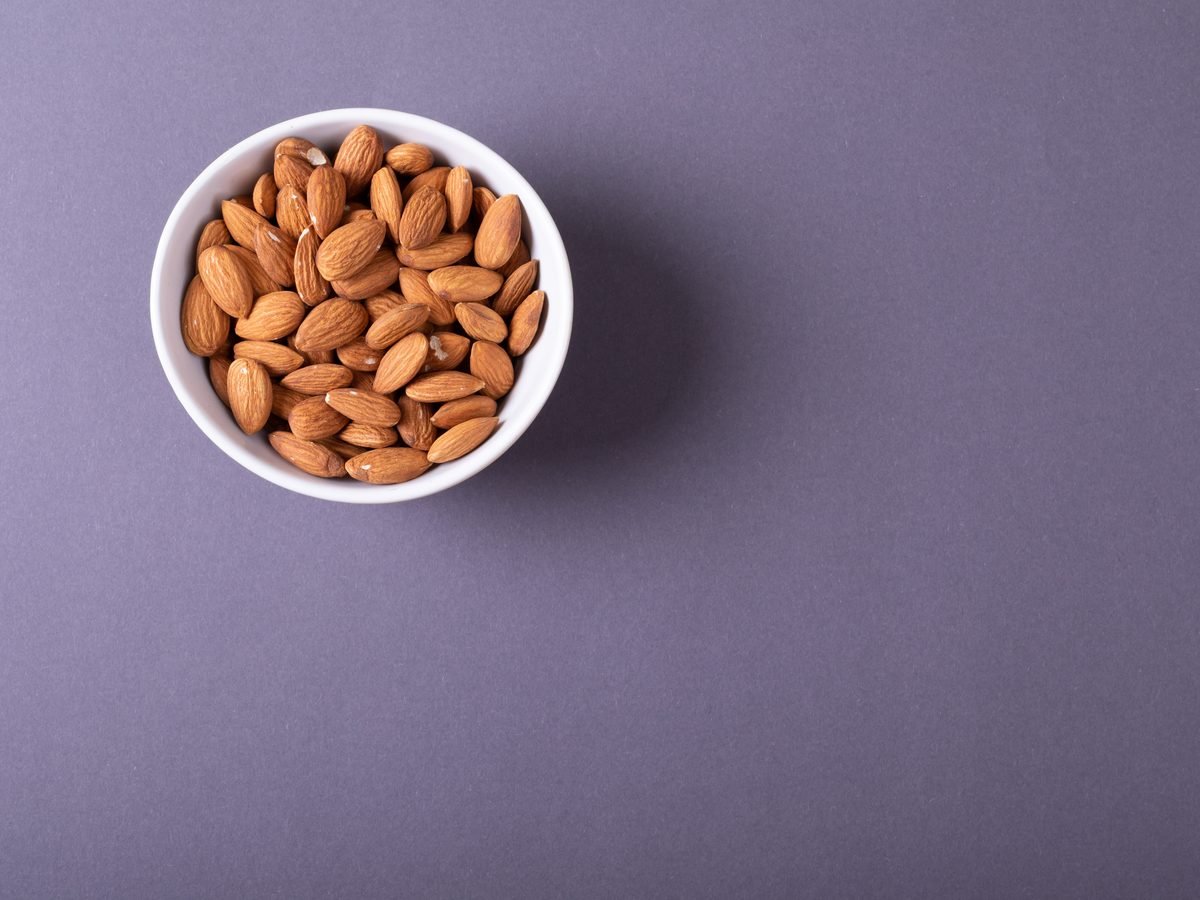
A plain dry-roasted almond pack
Step 1: The front panel says "a healthy snack" beside a protein callout. The wording is a claim.
Step 2: The ingredient statement says "almonds." Nuts are on the automatic-qualification list, and nothing else is present.
The product qualifies. Stop.
The saturated fat naturally present in the almonds never enters the analysis, and the step 6 records are not required.
Now add sea salt or roast the almonds in sunflower oil. The automatic route closes.
The product then moves to the nuts, seeds and soy row. It needs at least 1 oz-eq of nuts, no more than 1 g added sugars, no more than 230 mg sodium, and no more than 1 g saturated fat, excluding saturated fat naturally present in the nuts. In this example, that exclusion covers all of the saturated fat.
Sodium becomes the main question.
Because the RACC for a nut pack is well below 50 g, the applicable limit is tested per 50 g. Salt contributing 4 mg sodium per gram produces 200 mg per 50 g and passes. At 6 mg per gram, the product contains 300 mg per 50 g and fails.
A fruit-and-nut granola bar
Step 1: "The healthier bar" uses a covered term in a nutritional context.
Step 2: The bar contains oats, raisins, almonds, honey and cane sugar, so it does not qualify automatically.
Step 3: It combines multiple food groups and is not a main dish or meal. It is therefore a mixed product tested per RACC.
Step 4: Assume the oats provide 3/4 FGE of whole grain and the raisins provide 1/4 FGE of fruit. That gives the product 1 total FGE across two food groups, satisfying the minimum.
Step 5: Sodium is 95 mg, about 4% DV and below the 345 mg ceiling. Saturated fat is 1.5 g, below the 2 g ceiling.
Added sugars are 6 g from honey and cane sugar. Six grams divided by the 50 g Daily Value equals 12% DV, above the 10% DV limit. The bar therefore fails by 1 g.
Sugars naturally present in the raisins do not count as added sugars. Honey does.
Reformulating to exactly 5 g reaches 10% DV and passes, but that leaves little margin. Added sugars are declared to the nearest gram, while %DV may be calculated from the unrounded amount. A bar containing 5.4 g can declare 5 g but actually contain 10.8% DV.
A target of 4 g provides more room.
A canned vegetable soup
Steps 1 and 2: The healthy wording is a claim, and added salt closes the automatic qualification route.
Step 3: Treat the soup as a mixed product tested per RACC unless it genuinely satisfies the main dish definition in 101.13(m).
Step 4: Assume carrots, celery and tomato provide 3/4 FGE of vegetables and white beans provide another 1/4 FGE. The product reaches the required 1 total FGE across two food groups.
Now compare two formulations.
Formulation A contains 690 mg sodium per RACC. That is 30% DV, twice the mixed-product limit of 15% DV, or 345 mg. It fails.
Formulation B contains 310 mg sodium, about 13% DV. It passes, with no added sugars and 0.5 g saturated fat against the 2 g ceiling.
The vegetable content and FGE remain the same. Sodium alone changes the result.
If the soup actually qualifies as a main dish and is labeled accordingly, the test moves to the labeled serving and the sodium ceiling increases to 20% DV, or 460 mg. A 400 mg formulation would clear that nutrient limit.
The higher allowance comes with a higher food group requirement. A main dish needs 2 total FGE with at least 1/2 FGE from each of two groups, so a thin soup can fail the FGE test before benefiting from the higher sodium allowance.
What to do when your product cannot use a healthy food label
- Sodium. Reduce added salt, use no-salt-added or rinsed canned ingredients, and check whether a small-RACC food is actually being tested per 50 g. FDA's voluntary sodium reduction targets are guidance rather than requirements, but their category target means can provide a useful benchmark.
- Added sugars. Reduce sweeteners covered by the added sugars definition, including honey, maple syrup, cane sugar, syrups and juice concentrates. Sugars naturally occurring in whole fruit, vegetables, milk and 100% juice do not count as added sugars.
- Saturated fat. Consider changing the fat source, but check the exclusions first. Saturated fat naturally present in seafood, nuts, seeds and soy is excluded, so the qualifying amount may already be lower than the Nutrition Facts panel suggests.
- Food group equivalents. Increase the actual vegetable, fruit, whole grain, dairy or protein-food content, or confirm that the product is classified correctly. Reclassification is not a free pass because moving into another product type also changes the FGE requirement.
There is one final option: do not make the claim.
The healthy claim is voluntary. If a product misses the criteria, you can remove the regulated wording and describe the food accurately using other appropriate terms. That can be faster than reformulating a product that misses the added sugars threshold by 1 g.
Run the product through our claim validator before committing the claim to packaging.
Healthy food label requirements: frequently asked questions
Do I have to meet the new healthy label requirements now?
No. The rule was published on 27 December 2024 and is final, but using the claim remains voluntary and the compliance date is 25 February 2028. You may use the updated criteria now. After the compliance date, a product using one of the covered terms in a nutritional context must meet the updated definition.
Is there an FDA “healthy” symbol I can put on the package?
Not yet. There is no official FDA healthy symbol. FDA has said it continues to explore developing one, and potential guidance identifying a symbol appears on its 2026 agenda, but nothing has been issued. Any such symbol would be voluntary guidance, so do not build packaging around a mark that does not currently exist.
My product met the 1994 healthy definition. Does it still qualify?
Not necessarily. The 1994 definition used limits for total fat, saturated fat, cholesterol and sodium, plus 10% DV of at least one nutrient to encourage. The updated rule removes the total fat and cholesterol limits, replaces the nutrient minimum with food group equivalents, adds an added sugars limit, and reduces the individual-food sodium limit from 480 mg per RACC to 230 mg.
Fortified white bread, sweetened yogurt and sweetened cereal generally do not survive those changes, while salmon, nuts and olive oil can now qualify.
Does “healthier” on a comparison count as a healthy food label claim?
Yes. "Healthier" and "healthiest" are among the nine covered terms. A statement such as "a healthier choice than our original" must therefore satisfy the healthy criteria in its own right. Simply having a better nutrient profile than the previous formulation does not make the updated product eligible.
Once your answer is yes, the claim still needs to appear on a compliant package with correct serving sizes, rounding and %DV declarations. Build the panel in our Nutrition Facts label generator and keep the step 6 substantiation records with the artwork file so the claim and supporting formulation do not drift apart.